Tuesday, 12 January 2010

Research for Module 4 DNA Modules showing Liquid Crystal Phases


A microscope image showing that a solution of tiny DNA molecules has formed a liquid-crystal phase. The DNA molecules pair to form DNA double helices, which, in turn, stack end-to-end to make rod-shaped aggregates that orient parallel to one another. Image by Michi Nakata, University of Colorado. 

A team led by the University of Colorado at Boulder and the University of Milan has discovered some unexpected forms of liquid crystals of ultrashort DNA molecules immersed in water, providing a new scenario for a key step in the emergence of life on Earth.

Liquid crystals - organic materials related to soap that exhibit both solid and liquid properties - are commonly used for information displays in computers, flat-panel televisions, cell phones, calculators and watches. Most liquid crystal phase molecules are rod-shaped and have the ability to spontaneously form large domains of a common orientation, which makes them particularly sensitive to stimuli like changes in temperature or applied voltage.

CU-Boulder physics Professor Noel Clark said "We found that even tiny fragments of double helix DNA can spontaneously self-assemble into columns that contain many molecules. Our vision is that from the collection of ancient molecules, short RNA pieces or some structurally related precursor emerged as the molecular fragments most capable of condensing into liquid crystal droplets, selectively developing into long molecules."

Research for Module 4 Liquid Crystals


Liquid crystals (LCs) are a state of matter that has properties between those of a conventional liquid and those of a solid crystal[1]. For instance, an LC may flow like a liquid, but its molecules may be oriented in a crystal-like way. There are many different types of LC phases, which can be distinguished by their different optical properties (such as birefringence). When viewed under a microscope using a polarized light source, different liquid crystal phases will appear to have distinct textures. The contrasting areas in the textures correspond to domains where the LC molecules are oriented in different directions. Within a domain, however, the molecules are well ordered. LC materials may not always be in an LC phase (just as water may turn into ice or steam).

Examples of liquid crystals can be found both in the natural world and in technological applications. Most modern electronic displays are liquid crystal based. Lyotropic liquid-crystalline phases are abundant in living systems. For example, many proteins and cell membranes are LCs. Other well-known LC examples are solutions of soap and various related detergents, as well as tobacco mosaic virus.


Research for Module 4


The brief we've been given is to explode ideas around the theme Containers, so I'm looking at what's contained within a body. I'll be looking at cells, veins, water, arteries, organs, bones etc. Also Liquid Crystals, I'm already aware of their strong formations of pattern and colour.


Liquid Crystal
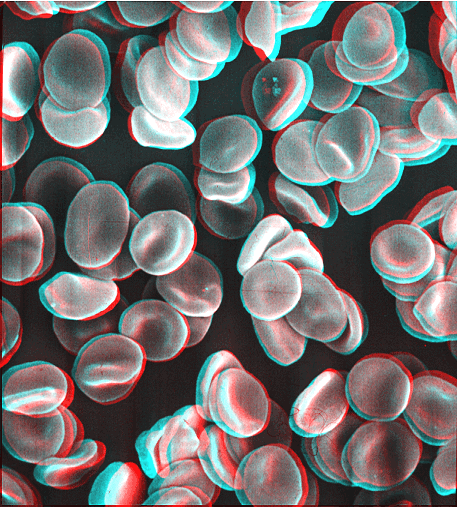
http://www.udel.edu/biology/Wags/histopage/wagnerart/anaglyphpage/red%20cells%20.gif
Red Blood Cells
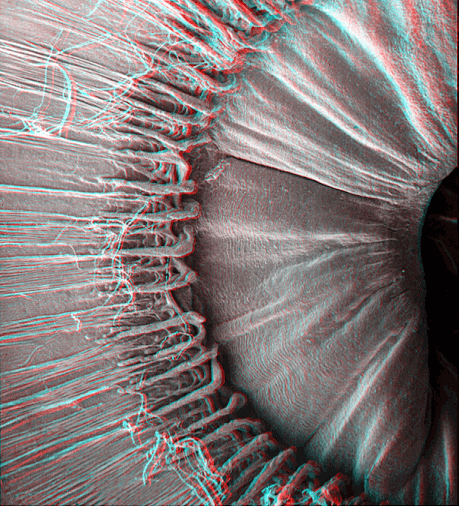
http://www.udel.edu/biology/Wags/histopage/wagnerart/anaglyphpage/iris.gif
Iris
website research

Thursday, 17 December 2009

Module 3 - Exhibition


I've gathered the most impacting statistics from my research and made comparisons to every day life to help people generate a more relating and understanding feel. The idea isn't to patronise, it's to help stimulate the mind into thinking of the cause in a more creative form.

I decided visual imagery would be best to portray the statistics as it's more engaging and opting for a sketchbook so that it would create an interaction between each message portrayed to the viewer. Different styles were used in each piece within in the sketchbook so that atleast one might have an affect on atleast one person.

I then chose a statistic from my sketchbook I felt would genertate the most appeal and felt would have more of a relation to the viewers and produced this as an installation.

Monday, 14 December 2009

Module 3 - Statistics for sketchbook

884,000,000 live without access to safe water. That is the equivalent of the whole of Britain being without water 14 times over.

1.4 million children die every year from diarrhoea caused by unclean water and poor sanitation - 4,000 child deaths a day or one child every 20 seconds. This equates to 160 infant school classrooms

The world is made up of 70% water but only 1% of that is safe drinking water. If the worlds water was poured into a bucket only a teaspoon would be drinkable.


The average person in the developing world uses 10 litres of water every day for their drinking, washing and cooking.
> 10 litres is the equivalent of 17 pints
> around 8-13 litres are used with a single toilet flush, the average household flushes 16 times a day.
> 80 litres are used per shower, that’s 320 litres per average household.

The average person carries 20kg on their head for 6km. That’s the equivalent of carrying a baby elephant on your head up and down a football pitch 6 times.
OR 8 bags of groceries on your head from Stockport to Manchester.
OR the average UK airport luggage allowance on your head the around the perimeter of Manchester airport twice.

MDG (Millennium Development Goals) aims to meet the annual cost of water and sanitation by 2015. That cost is £8 billion.
Europeans spend about £6 billion on ice cream every year.

Monday, 7 December 2009

Module 3 - Sunspring water filter


The Sunspring™ is a solar powered, portable, self-contained water purification system that provides an opportunity to have clean water in more remote sites and areas of developing nations not currently serviced with water treatment. Here in the United States, the Sunspring™ can provide clean, safe water in locations such as parks and campgrounds, and has countless other applications.

Businesses and small communities in remote locations can now take advantage of the same membrane technology used by large-scale water treatment plants in a compact, self-contained alternative energy design.

Module 3 - Statistics

A global crisis

  • 884 million people in the world do not have access to safe water. This is roughly one in eight of the world's population. (WHO/UNICEF)
  • 2.5 billion people in the world do not have access to adequate sanitation, this is almost two fifths of the world's population. (WHO/UNICEF)
  • 1.4 million children die every year from diarrhoea caused by unclean water and poor sanitation - 4,000 child deaths a day or one child every 20 seconds. This equates to 160 infant school classrooms lost every single day to an entirely preventable public health crisis. (WHO/WaterAid)

What has WaterAid done?

  • Since WaterAid was established in 1981 we have reached 13.44 million people with safe water. Since 2004 we have reached 8.16 million people with sanitation.
  • Last year WaterAid reached over one million people with safe water and over two million people with sanitation.
  • Just £15 can enable one person to access safe water, improved hygiene and sanitation. (WaterAid)

Sanitation

  • Diarrhoea kills more children every year than AIDS, malaria and measles combined. (WHO)
  • Children living in households with no toilet are twice as likely to get diarrhoea as those with a toilet. (WEDC)
  • Every year, around 60 million children in the developing world are born into households without access to sanitation. (UN Water)
  • One gram of human faeces can contain 10,000,000 viruses, 1,000,000 bacteria, 1,000 parasite cysts, 100 parasite eggs. (UNICEF)
  • At any one time half the hospital beds in developing countries are filled with people suffering from diarrhoea. (UNDP)

Hygiene

  • Hand-washing with soap at critical times can reduce the incidence of diarrhoea by up to 47%. (UN Water)
  • The integrated approach of providing water, sanitation and hygiene reduces the number of deaths caused by diarrhoeal diseases by an average of 65%. (WHO)

Water

  • The weight of water that women in Africa and Asia carry on their heads is commonly 20kg, the same as the average UK airport luggage allowance. (HDR)
  • The average person in the developing world uses 10 litres of water every day for their drinking, washing and cooking. (WSSCC)
  • The average European uses 200 litres of water every day for their drinking, washing and cooking. North Americans use 400 litres. (HDR)
  • On current trends over the next 20 years humans will use 40% more water than they do now. (UNEP)
  • Agriculture accounts for over 80% of the world's water consumption. (UNEP)
  • 97.5% of the earth's water is saltwater. If the world's water fitted into a bucket, only one teaspoonful would be drinkable. (HDR)

Education and livelihoods

Kenedy Gondwe, sanitation promoter, with his wife and son, in his field of maize, Chikompulazi village, Mzuzu, Malawi
Kenedy Gondwe's family have been able to earn an income from growing maize since they gained access to clean water.
Credit: WaterAid/Layton Thompson
  • For every $1 invested in water and sanitation, $8 is returned in increased productivity. (UNDP)
  • Lack of safe water and sanitation costs sub-Saharan Africa around 5% of its Gross Domestic Product (GDP) each year. (UNDP)
  • 443 million school days are lost each year due to water-related diseases.
  • 11% more girls attend school when sanitation is available. (UK DFID)
  • Households in rural Africa spend an average of 26% of their time fetching water, and it is generally women who are burdened with the task. (UK DFID)

Millennium Development Goals

  • 1.2 billion people gained access to sanitation between 1990 and 2004. (UN Water)
  • Nearly half the people who gained access to water between 1990 and 2006 live in India and China. If this rapid progress in these two countries were discounted, we would not achieve the water MDG target to halve the proportion of those living without safe water until 2025.
  • 1.7 billion people will still need sanitation even if the 2015 MDG sanitation goal to halve the proportion of people without sanitation is reached. (WHO/UNICEF)
  • The annual cost of meeting the water and sanitation MDG targets up to 2015 is US$11.3 billion. (UN Water)
  • Europeans spend about US$10 billion on ice cream every year. (HDR)
  • No sub-Saharan African country is on-track to meet the sanitation MDG. (WHO/UNICEF)

Financing the sector

  • Over the past 10 years, aid to health and HIV/AIDS in Sub-Saharan Africa has increased by nearly 500%, while aid to water and sanitation has increased by only 79%. (OECD)

Water and sanitation in history

  • South Korea made huge investments in water and sanitation during the 1960s, when its per capita income was the same as Ghana's, and during that decade, under-five mortality more than halved, while the number of medical staff stayed virtually the same. (WaterAid)
  • In the UK the expansion of water and sanitation infrastructure in the 1880s contributed to a 15 year increase in life expectancy in the following four decades. (HDR, 2006)

Abbreviations used
DFID – UK Department for International Development
HDR - UN Human Development Report
OECD – Organisation for Economic Co-operation and Development
UNDP – United Nations Development Programme
UNEP – United National Environment Programme
UNICEF – United Nations Children’s Fund
WEDC – Water Engineering Department, University of Loughborough
WHO – World Health Organization
WSSCC – Water Supply and Sanitation Collaborative Council