Tuesday, 12 January 2010

Rsearch for Module 4

http://img.thesun.co.uk/multimedia/archive/00785/Cancer-Cells_682_785682a.jpg
Abnormal abdominal cells found in a smear test, currently smear tests are not available for under 25s.

One in three women under the age 25 will have an abnormal result compared with one in 14 for older women, the ACCS said, meaning that there are many false positives identifying abnormal changes in cells that often return to normal without treatment.

Cervical cancer in under-25s remains rare, with only 56 cases diagnosed in England in 2006.

Research for Module 4

I've noticed with a lot of the cell slides, they contain really beautiful shapes, colours and patterns but for most of the cells I've looked at they are potentially life threatening abnormal cells that cause diseases. It's a real issue in society that affects a lot of people. In a design aspect I like juxtapositioning the aspects of potentially life threatening illnesses with the ironic beauty of the slides and I'd like to explore the aspect of these issues to give meaning behind my work.

Research for Module 4

Bone Marrow Slides
http://www.healthsystem.virginia.edu/internet/hematology/HessImages/Metastatic-carcinoma-50x-website.jpg
Metastatic carcinoma
http://www.healthsystem.virginia.edu/internet/hematology/HessImages/Metastatic-carcinoma-100x-website.jpg
Metastatic carcinoma
http://www.healthsystem.virginia.edu/internet/hematology/HessImages/Prostate-cancer-50x-website.jpg
Prostate Cancer
http://www.healthsystem.virginia.edu/internet/hematology/hessimages/reactive-plasma-cells-in-a-perivascular-position-50x-website-arrow.jpg
Reactive plasma cells in a perivascular position
http://www.healthsystem.virginia.edu/internet/hematology/HessImages/Starry-sky-100x2-website-arrow.jpg
Starry Sky (histiocyte engulfment of Burkitt cells)

Research for Module 4

http://www.healthsystem.virginia.edu/internet/hematology/images/Plasma-cells-website.jpg
Plasma 1
http://pleiad.umdnj.edu/hemepath/pc/graphics/benignpcsmear504x386.jpg
Plasma 2
http://www.healthsystem.virginia.edu/internet/hematology/hessimages/multiple-myeloma--flame-shaped-plasma-cell-100x5-website-arrow.jpg
Plasma Cells 3
http://www.nature.com/modpathol/journal/v17/n4/images/3800080f1.jpg
Plasma Cells 4

Research for Module 4 DNA Modules showing Liquid Crystal Phases


A microscope image showing that a solution of tiny DNA molecules has formed a liquid-crystal phase. The DNA molecules pair to form DNA double helices, which, in turn, stack end-to-end to make rod-shaped aggregates that orient parallel to one another. Image by Michi Nakata, University of Colorado. 

A team led by the University of Colorado at Boulder and the University of Milan has discovered some unexpected forms of liquid crystals of ultrashort DNA molecules immersed in water, providing a new scenario for a key step in the emergence of life on Earth.

Liquid crystals - organic materials related to soap that exhibit both solid and liquid properties - are commonly used for information displays in computers, flat-panel televisions, cell phones, calculators and watches. Most liquid crystal phase molecules are rod-shaped and have the ability to spontaneously form large domains of a common orientation, which makes them particularly sensitive to stimuli like changes in temperature or applied voltage.

CU-Boulder physics Professor Noel Clark said "We found that even tiny fragments of double helix DNA can spontaneously self-assemble into columns that contain many molecules. Our vision is that from the collection of ancient molecules, short RNA pieces or some structurally related precursor emerged as the molecular fragments most capable of condensing into liquid crystal droplets, selectively developing into long molecules."

Research for Module 4 Liquid Crystals


Liquid crystals (LCs) are a state of matter that has properties between those of a conventional liquid and those of a solid crystal[1]. For instance, an LC may flow like a liquid, but its molecules may be oriented in a crystal-like way. There are many different types of LC phases, which can be distinguished by their different optical properties (such as birefringence). When viewed under a microscope using a polarized light source, different liquid crystal phases will appear to have distinct textures. The contrasting areas in the textures correspond to domains where the LC molecules are oriented in different directions. Within a domain, however, the molecules are well ordered. LC materials may not always be in an LC phase (just as water may turn into ice or steam).

Examples of liquid crystals can be found both in the natural world and in technological applications. Most modern electronic displays are liquid crystal based. Lyotropic liquid-crystalline phases are abundant in living systems. For example, many proteins and cell membranes are LCs. Other well-known LC examples are solutions of soap and various related detergents, as well as tobacco mosaic virus.


Research for Module 4


The brief we've been given is to explode ideas around the theme Containers, so I'm looking at what's contained within a body. I'll be looking at cells, veins, water, arteries, organs, bones etc. Also Liquid Crystals, I'm already aware of their strong formations of pattern and colour.


Liquid Crystal
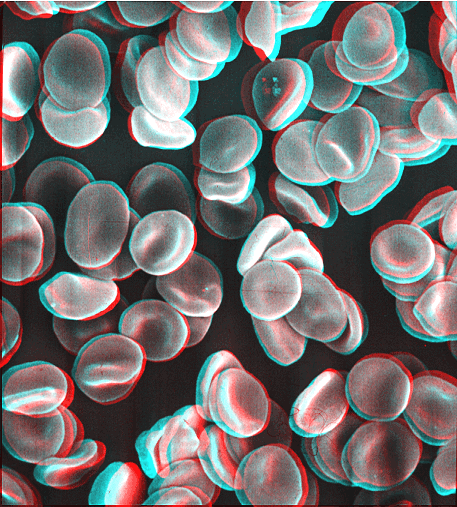
http://www.udel.edu/biology/Wags/histopage/wagnerart/anaglyphpage/red%20cells%20.gif
Red Blood Cells
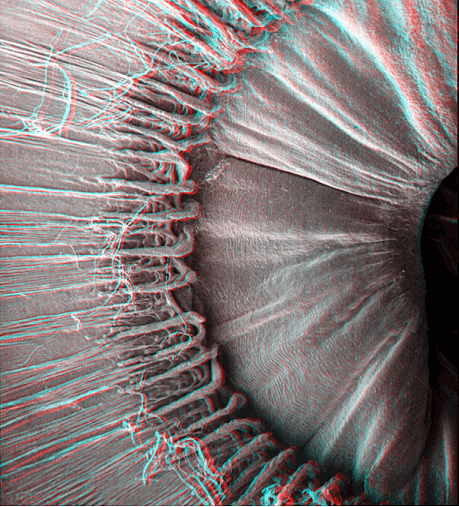
http://www.udel.edu/biology/Wags/histopage/wagnerart/anaglyphpage/iris.gif
Iris
website research